This summer, I spent around 11 weeks at the Harvard Forest Summer Research Program in ecology. I had loads of fun spending time making new friends, spending time outdoors, and gaining a better idea of what I want my career to look like as an aspiring ecologist. I am so grateful for this experience, and it has been nothing short of transformative. This summer, I joined ecologist Dr. Andrew Reinmann and his project at the Harvard Forest CliFF (Climate Interactions in Forest Fragmentation) site, studying the impacts of forest fragmentation and water availability on ecosystem carbon fluxes and tree ecophysiology in temperate forests. This experience highlighted the critical role of below-ground ecosystem processes, revealing that far more is happening than what we see above the surface.
Within this larger project, I studied the impacts of forest fragmentation and climate on soil fluxes of CO₂ and CH₄. What initially drew me to this project was its broad application for a wide range of ecosystems and scenarios. In our changing world, forest fragmentation is becoming much more common, and as of 2015, 70 percent of our world’s forest exists within 1 kilometer of a forest edge. With changes to our earth’s climate, I thought it would be beneficial to understand how the largest driver of ecosystem carbon flux is impacted by these two anthropogenic drivers, which will then help account for a more detailed understanding of ecosystem net primary productivity (NPP). As a researcher from Hawaiʻi, I was motivated to pursue work that could be applied to island ecosystems. Examining the effects of temperature and moisture on soil respiration provides a framework for understanding processes back home.
To start, I learned that forest soil fluxes of CO₂ and CH₄ are largely driven by two metabolic processes: 1. autotrophic respiration (which is the process of plants breaking down sugars from photosynthesis to fuel their growth, releasing carbon as a byproduct) and 2. heterotrophic respiration (which is respiration performed by organisms that break down organic matter). The two largest variables impacting soil respiration are temperature and moisture (volumetric water content). Soil CO₂ respiration levels tend to peak at around 25 degrees Celsius, while too much or too little moisture can both negatively affect respiration levels. Soil respiration dynamics then become more complex when forest fragmentation is considered. At a forest edge, temperate forests often experience around a 15-26 percent increase in growth due to the altered microclimates from more sunlight, higher temperatures, and wind availability. From a carbon sequestration standpoint, we also end up seeing greater carbon uptake at an edge than in the interior within temperate forests.
With this information in mind, I developed two different questions for my research at Harvard Forest.
How does soil respiration vary across an edge-to-interior gradient?
With forest fragmentation becoming increasingly prevalent, I was curious about how soil respiration levels would be affected. This way, we could develop an improved understanding of carbon dynamics in our changing world.
What are the roles of temperature and moisture in influencing the response of soil respiration?
With climate projections in the New England region projected to increase by 5.8 to 6.8 degrees Celsius by 2080, and precipitation patterns expected to increase by 3 – 5 percent per Celsius increase of local warming in the Northeast United States, I sought to understand how soil respiration would be affected under future climate scenarios.
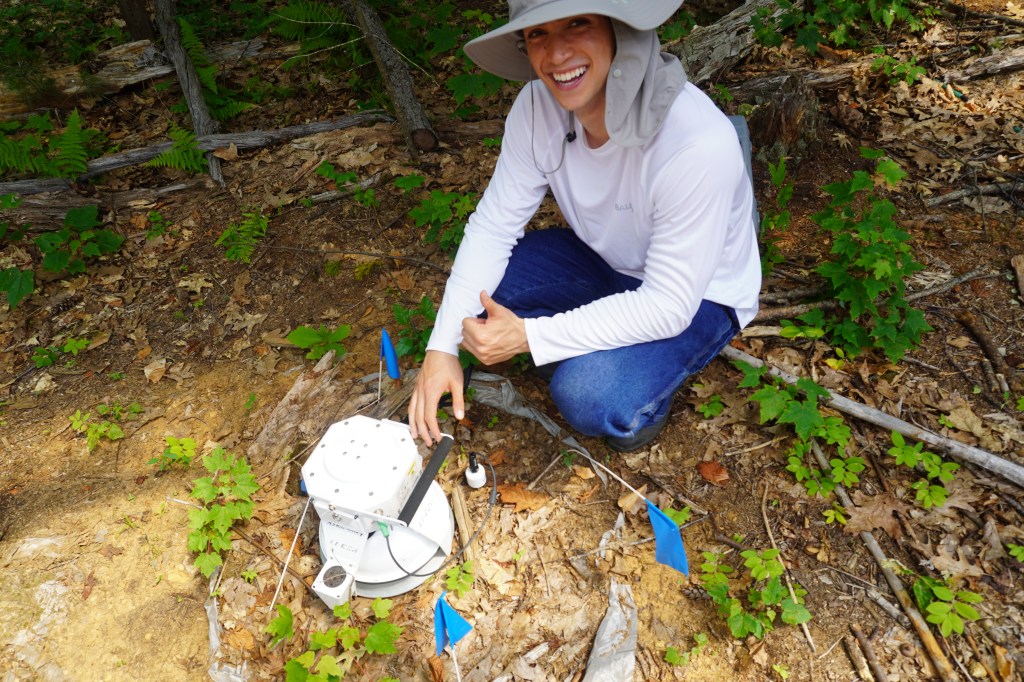
After developing my research question, I spent a total of 5 weeks measuring soil respiration across an edge-to-interior gradient at the Harvard Forest CliFF site within three different climate scenarios. There were 6 plots at the Harvard Forest CliFF site, with the first two representing total throughfall removal through installing plastic around trees to direct the water to a basin in the middle of the clearing, two representing our reference scenarios, and the last two representing our throughfall addition plots, where we hoped to pump water we collected from the first two plots to this area. However, for the sake of this experiment, I focused on comparing the throughfall removal plots and the reference plots, as we didn’t have enough rain this summer to significantly increase precipitation. Collars were measured at around 10 m increments up to 30 m into the forest. Regarding instruments, I used the LI-7810 and 8100-01S Smart Chamber (LI-COR Biosciences) series.
In comparing the control and drought plots, I found that drought seems to suppress the edge effect on respiration, and as we move from the edge to the interior of the forest, we see a gradual increase in soil respiration. This is typical in new forest edges, as new forests are often more impacted by the microclimatic conditions at an edge due to less lateral growth and leaf fall attributed to maturity, which all contribute to less soil respiration than older forests. I then looked at the drought plots’ effect on soil respiration and noticed that the CO₂ flux measurements were around the same across the forest spatial gradient! Drought plots do not have the same relationship to distance as the control plot does, suggesting that moisture is a limiting factor.
Additionally, temperature tended to increase slightly with CO₂ flux in the control plot, which I expected. Then when looking at the drought plots, I saw that there tended to be similar levels of respiration in the drought plot, even with the increased temperature! This pointed to moisture as a limiting factor. Then when I looked at the volumetric water content of the drought and control plots, I saw two contrasting results across both plots. Within the control plot, I saw as VMC increased to around 30 percent that it correlated with an increased level in respiration. When we looked at the VMC levels within the drought plot and their corresponding respiration levels, we saw significantly lower VMC and respiration levels, further pointing to VMC also limiting the inducement of temperature on soil respiration!
This project taught me that moisture seems to be a more influential factor in soil respiration, with temperature being the secondary driver.
As a new researcher, this experience taught me that the process of coming to a conclusion to your answers within science isn’t always so straightforward! For example, initially, it didn’t cross my mind that the age of a forest could have a significant effect on soil respiration levels. I thought that the age of a forest wouldn’t be an influential factor on respiration, as I thought that all forests would follow a trend of respiration increasing at an edge, then decreasing as they moved towards the interior. However, I found that mature forests tend to have increased respiration levels at the edge, which would then taper gradually as one moves to the first interior. I found that newer forests exhibit this reverse relationship, with newer forests having suppressed respiration at the edge in comparison to the interior. This tends to be due to part of the maturity of the forest affecting processes such as leaf litter fall and the amount of lateral growth present at the edge. These mature conditions tend to dampen the negative effects of the extreme microclimate by blocking out extra heat while still having increased levels in soil respiration. With this research providing me a basic understanding of carbon cycling in relation to climatic and fragmentation influences, I hope to apply this information back home to my state of Hawaiʻi, where one day, I hope to become a climate ecologist focused on preserving Hawaiʻi’s ecosystems. Hawai’i has already lost half of its endemic forest cover since the onset of human arrival, and with more and more individuals moving to Hawai’i and our population expanding, more and more forests are expected to be fragmented, therefore risking altering our forests from carbon sources to sinks. Our forests are also younger due to the fact of being an island; our geological formations are much younger than forests on the continent, allowing these ecosystems to have a longer period of colonization. The need for proper land management strategies has become ever so important. Especially in the wake of the devastating forest fires of Lahaina in 2023, it was uncovered that a combination of forest fragmentation, invasive species, and the mismanagement of our state’s water resources created the perfect condition for this devastating event to occur. I hope that proper understanding of carbon cycling in Hawaiʻi’s ecosystems could help incentivize their protection to further prevent the frequency of natural disasters from occurring. I want to say thank you to everyone at Harvard Forest for encouraging me this summer, to Chefs Tim and Peter for feeding me, and to my mentors Andy, Joe, Junior, JP, and Grady, who always answered any questions I had about my project. I also want to say how indebted I am to everyone in this program for increasing my passion for ecology, which I will carry with me for the rest of my life.
Me and my fellow club member (second from the left) both served as food policy interns at Purple Mai’a, an organization dedicated to tracking food and agriculture legislative measures. As interns, we both attended the Ma’o Farms ‘’Pehea ka ‘Āina’’ talk-story event on the importance of organic farming in our local communities.
After falling extremely ill at my previous university, I made the difficult decision to return home to recover. With nowhere else to turn, I attended a local community college out on the coast of Waiʻanae, tucked behind rural developments right next to the beach. The school was small, with less than 100 students on campus at a given time. To further my educational journey, I joined the school’s support program and utilized any resources I could find. After my first day of school, I vividly remember searching for the school’s food bank, hoping no one would see me. However, I ended up joining all of my classmates who were also waiting outside room 121 along with me.
Out of sheer curiosity, I tracked the number of students reliant on my school’s food bank and compared the results to our college’s other campus location, which is 19 miles away. In comparing student reliance between the two locations, I found the other campus had <1% of their students utilizing their food bank’s resources, while the Waiʻanae campus had a utilization rate of 36%.
To find an answer to the higher rate of food insecurity, I took a step outside my campus. To put it kindly, Waiʻanae exists in stark contrast to the tropical paradise Hawaiʻi has been presented as. The dry coast of Waiʻanae on the island of Oʻahu provides an ideal location for 11 out of 18 of our state’s sewage treatment plants, active landfills, and power plants. Moreover, the majority of residents in this area are of Native Hawaiian descent (around 60.8% of the total population). With most people in Waiʻanae living below the poverty line, these factors, ranging from structural to economic variables, make residents particularly vulnerable to injustices (Levine, 2011).
Leeward Community College has two locations: one towards the central area of the island of O’ahu, our Pu’uloa campus, and the other on the coast of Waiʻanae, our Waiʻanae Moku campus, which is where my story takes place. Photo credit: Leeward Community College
This led to my investigation of the inequities experienced by residents on the Waiʻanae coast, particularly in light of Hawaiʻi’s history of colonialism and integration of various racial groups. This not only helped me understand which communities are most affected by environmental justice issues in Waiʻanae, but also across the state of Hawaiʻi.
Background Information
Prior to the colonization of the Hawaiian islands, the philosophy of Native Hawaiian culture created a lifestyle that lived in tune with the land, seeking to conserve the natural resources and ecosystems to sustain a viable way of life. Furthermore, Hawaiians used a land tenure system. It consisted of the undivided use of land rights, with Hawaiians viewing their land as communal, rather than the Western concept of privately owned property. As foreigners were introduced to Hawaiʻi, the idea of undivided use of land rights transformed into the new concept of private ownership. This led to the suppression of Hawaiians’ relationship with the land as well as their cultural practices.
The event that enabled the purchase of Hawaiian land was the Great Mahele. In 1848, King Kamehameha II divided the land into three groups: one belonging to himself or the sovereign ruler or king (mo’i), one belonging to the 245 chiefs (ali’i) throughout the islands, and another for government lands (Kometani, 2022). This division resulted in the separation of the crown lands from the lands controlled by the legislature. Westerners living on the islands took advantage of this by taking the lands for chiefs and the government. By the end of the 19th century, most of the land was in foreign hands.
At this time, the Kingdom of Hawaiʻi was a sovereign nation with treaties signed with the U.S. and other countries. However, this did not prevent an American-led coup from illegally overthrowing the Hawaiian monarchy, leading to the establishment of the Republic of Hawaiʻi. Then, in 1898, the U.S. accepted the annexation of Hawaiʻi. This process led to Native Hawaiians losing almost all control of their land by 1959.
The high population of Native Hawaiians on the Waiʻanae coast can be attributed to the Hawaiian Homes Commission Act. Created in 1921, it set aside around 200,000 acres of ceded land to be leased as farmlands and residences for Native Hawaiians. However, this homestead program has been underfunded, and many Native Hawaiians who applied decades ago have still not received anything. Furthermore, most of the land designated for homesteads is of poor quality, since the sugarcane industry has lobbied to keep the best agricultural land for themselves. The fact that this area has the highest population of Native Hawaiians in the world, coupled with many other ethnic minorities, creates issues of economic and environmental justice. Most of these residents live below the poverty line, more than double the poverty level of the rest of Oʻahu. The lack of political power and representation within this community creates an unfavorable environment for community members to voice their opposition against environmental abuses.
Looking at Waiʻanae’s history also led me to examine other environmental justice cases in our state. After analyzing the recent devastating events of the Lahaina fires, I found that fixing our food system will not only benefit my own community, but also could have prevented what happened in Maui.
Lahaina was once a wetland filled with lo’i patches of kalo, Hawai’i’s staple food crop, irrigated by mountain streams. Mokuhinia, a 17-acre fishpond, was filled with so many fish that it only took a handnet to collect a fresh catch. Niu (coconut) and ‘ulu (breadfruit) trees were common occupants, providing residents with abundant food. By the mid-19th century, Lahaina had become a rollicking port for whalers. Around that time, wealthy European plantation owners sought tropical climates to grow pineapples and sugarcane, ultimately leading them to the island of Maui. In doing so, native forests and local food crops were decimated, being burned and cleared down for plantation grounds.
More than Hawaiʻi’s traditional system of food production was disrupted. The once lush scenery of Maui turned into fields of pineapple and sugarcane, as well as pasturelands for cattle, which brought in invasive species such as guinea grass, buffle, and molasses grasses. The introduction of these grasses, characterized by their dry and fast growth, was combined with the diversion of Maui’s water from residential areas to developers. This created a dry and arid landscape, resulting in the perfect conditions for fires to occur.
Current Actions
To work towards solving these issues, I transformed our school’s student support program into our college’s first-ever Environmental Justice Club, and by using sustainable agriculture as a leverage to optimize the health of the environment around us, we addressed our school’s need for food security.
In hopes of learning how we could create a sustainable food system in Hawaiʻi, I was reminded of Hawaiian culture’s close relationship to the land. In order to survive solely with the resources provided on these tiny masses of land in the middle of the vast Pacific Ocean, one had to live in a way that would ensure their survival for generations. Native Hawaiians created a thriving society within the ecological boundaries of our islands, in tune with the world around them. Through the Ahupua’a, a land division from the mountains (mauka) to the sea (makai), one could see the relationship between humans and the environment. One of my favorite reads showcasing this has been“Islands and Cultures: How Pacific Islands Provide Paths toward Sustainability’ by Dr. Vitousek, who coincidentally is a Stanford Professor. In his book, Vitousek analyzes Polynesian cultures in their formation of human-environment systems, showcasing that the Polynesian islands can serve as useful models for how human societies interact with the land around them, providing insights for global sustainability efforts. This model system created by Polynesian cultures became something our club used as inspiration for reshaping the current state of Hawaiʻi’s food system.
The infamous Ahupua’a poster depicts aspects of pre-contact Hawaiian life before foreign influences changed the environment and lifestyle of the Hawaiian people. This photo was taken outside Leeward Community College’s Waiʻanae Moku’s food bank. Photo credit: Timothy Wiley, poster by Mary Kahalewai.
Coming from Leeward Community College Waiʻanae Moku, I had access to knowledge beyond the classroom, and I learned so much through the people around me. In hopes of learning more about the benefits of an indigenous food system, I was reminded of the generational knowledge our kūpuna (elders) held. Beyond the initial goal of my club in providing a platform for people to share their voices and struggles as a community, I unknowingly tapped into a wealth of information, with each person having a unique story with new perspectives. In indigenous cultures, the primary means of information being passed down through generations is through oral communication rather than written history, which meant I learned greatly from listening to the stories of the people around me. One person I spoke to shared how growing Kalo was important to him and talked about the techniques he used to grow this important food crop. Another Kūpuna, my grandmother, shared with me a recipe for a culturally significant fish, one that no one else in my family has. Another person I spoke to shared a crucial piece of information behind the history of Waiʻanae: the meaning behind its name. The Waiʻanae Coast (wai means water, while ʻanae translates to large mullet) was named for the mullet that was once commonly farmed and produced in large amounts in the backshore on many Waiʻanae beaches. This reminded me of how Hawaiʻi could find inspiration in its past as we seek to change the present state of our food system.
One of these people who has played a huge role in my career as an environmentalist and mentor for me was my uncle. Out in Waiʻanae, he took on the strenuous task of operating one of the last cattle ranches on the island, supplying locally and sustainably raised beef to the people on the Waiʻanae coast. He would regularly sell his meat at local farmer’s markets and support local organic farms by trading beef for the produce they supplied. To cut down on food waste, he reached out to local grocery stores for their food that was nearing the end of its shelf life and used it as food for his pigs. His dedication to helping our community was something that I took note of. Sadly, he recently passed away, but I plan on continuing his mission of feeding Hawai’i in a way that ensures the success of our society for generations.
My club and I worked from various angles to address the food insecurity issue on the Waiʻanae coast. Through gathering funding, we took care of our campus garden of indigenous food crops and created worm bins to recycle the food waste our campus produced, feeding the gardens on our campus. To learn more about how to address these issues, I volunteered with organizations that granted me information to provide to my club. One of which was Paepae o He’eia, an organization dedicated to caring for the ancient He’eia fishpond, which was built over 800 years ago and provided native Hawaiians with substance. When asking the organization about what made Hawaiʻi’s fishponds so special, they explained to me how ancient Hawaiians were able to understand the environmental processes specific to Hawaiʻi, and utilized them to their advantage. Their aquaculture techniques are found nowhere else on earth. The rock walls of the fishponds included openings covered by stick grates to allow smaller fish to enter the ponds, leaving out larger fish. Once in the pond, fish feed on the site’s rich vegetation until they reach harvest size. Through building a fishpond where freshwater streams met the ocean, native Hawaiians understood they could create brackish water and stimulate the ideal environment for limu (algae) to proliferate, providing food for young fish as well as pāpa’i (crab) and ‘ōpae (shrimp). Their method of raising fish ensured that they always had food for future generations (Kelly, 1976).
I also attended a conference on the importance of supporting the growth of local agriculture businesses through the Ma’o Farms ‘’Pehea ka ‘Āina’’ event. Farmers and various leaders in Hawaiʻi’s food system shared their journeys to discover the importance of organic farming in improving the well-being of the people of Hawaiʻi. One thing that resonated with me was how they brought up the current social state of Waiʻanae. For context, in the past couple of months, there has been a significant increase in crimes and murders along the Waiʻanae coast. The guest speakers then shared how incorporating sustainable agriculture practices in Wai’anae will nurture far more than just crops. It would breathe life into our community. One of the speakers from Ma’o Farms shared how discovering their passion for gardening provided them with a greater purpose in life, and they discovered their passion for mentorship through sharing this experience with others. Another speaker shared their vision of getting the future generation involved in their culture through gardening, providing a path for success for at-risk youth.
Me and my fellow club member (second from the left) both served as food policy interns at Purple Mai’a, an organization dedicated to tracking food and agriculture legislative measures. As interns, we both attended the Ma’o Farms ‘’Pehea ka ‘Āina’’ talk-story event on the importance of organic farming in our local communities. Photo credit: Timothy Wiley
Through an internship I received on sustainable food policy in Hawai’i, I was able to tackle food insecurity on a whole new level. With my newfound knowledge of the legislative process, our club worked together to track bills related to sustainable agriculture. We spoke with local senators and news outlets about our college’s vision to bring life to the Waiʻanae community, and we worked on submitting testimonies and creating community awareness about various bills that aligned with our goals. During Hawaiʻi’s 2024 legislative session, there were two bills that caught our attention: Senate Bill 2414, relating to sustainable food systems, and House Bill 2590,relating to food security.
SB2414 addressed the benefits of a sustainable food system. What stood out to me about this bill is its recognition of the various factors that create a healthy food system and its implications beyond just food insecurity. This bill integrates the various members within our community, aiming to unite producers, retailers, and government agencies in the establishment of a sustainable food system working group in our state’s department of agriculture. The sustainable food systems working group aimed to develop an interagency food systems plan that is linked to the United Nations Sustainable DevelopmentGoals in order to integrate the objectives of “green” job creation, sustainable economic development, land stewardship, food security, environmental protection, and climate change resilience while keeping community health and well-being in mind. With our current food system being so flawed and 90% of our food in Hawaiʻi being imported into our state, it became obvious how beneficial reshifting our food economy to one that is more local would be, sustaining the social, economic, and environmental health of Hawai’i (Jany, 2023). Especially coming from Waiʻanae, a community that experiences the bulk of our island’s pollution and environmental burdens, this bill will help to address these issues through the development of a sustainable food system.
The other bill of primary interest to our club was HB 2590. This bill combined our need to address the rising issue of food security in our community while supporting our local economy, aligning with our club’s vision for a sustainable future. The bill appropriates funds for food bank purchases from local farmers, and took notice of the same observations I held based on my own analysis of our school’s disproportionate need for food assistance. HB 2590 concluded that food insecurity is a critical issue in the state of Hawaiʻi. With the cost of food in the state increasing by more than 5 percent in the past 12 months, the bill sought to solve this issue by purchasing food from local farmers for food banks to support a local economy, all while benefiting those in need.
When speaking with community members on the Waiʻanae coast, my club observed a common sentiment in their vision for Waiʻanae, sharing their hopes for a future where our dependence on food supply is not from elsewhere but grown here in the islands. Often, people have expressed not only this but also their frustration with the high cost of groceries, which makes food accessibility difficult. Even with safety net services like SNAP, WIC, and DA BUX, insufficient funding in these programs or regulations often makes people ineligible to receive benefits. A friend from my food policy internship conducted a study comparing the state allocations of each of our states funding for their DaBUX programs, a program allowing SNAP users to receive 50% off local produce, and found that Hawaiʻi, despite our food insecurity level being higher than the national average, had one of the lowest levels of state funding (Ezzy, 2024).
In hopes of the passage of these bills, my club worked on gaining community support and awareness about each of these bills and their implications. We went to agriculture events to teach high school students about how they can utilize their voice in the legislative process, showcasing the bills that were important to us. This Earth Day, our club helped with a tabling event with my internship organization at my community college to teach college-age students about understanding the bills in this year’s legislative session. Our club even created a petition to gain support for SB 2414, gaining signatures from scientists, food system experts, EJ advocates, farmers, and students. Through reaching out to a local news outlet to share my club’s story, a newspaper published an article about our school’s vision to bring life to the Waiʻanae coast community through sustainable agriculture.
Reflections/Moving Forward
Despite all our efforts, this legislative session resulted in the deaths of SB 2414 and HB 2590. However, a newfound passion was born within me. Before entering community college, I was unaware of the issues present in my community of Waiʻanae, nor did I even know what environmental justice was. Being in my current situation opened up my eyes to the injustices present in the place I call home, and this is where my story begins in joining Hawaiʻi’s environmental justice movement, which has also made me aware of other injustices in our state and their interconnectedness to the conditions in Waiʻanae. Even with the death of these bills, our community college was able to learn about the benefits of the reformation of our food system, and most importantly, we learned how to uplift the voices of the people around us.
The fight is far from over. These same topics will continue to be discussed in next year’s legislative session and these same bills will be reintroduced. However, our community will be there, continuing to fight until we achieve our goal of creating a future where our society lives in harmony with the environment around it, much like in the past. My time at community college has redirected me to a career as a future environmental justice advocate. One day, I hope to become an environmental scientist, studying the intersection of indigenous knowledge and sustainability in order to protect my home of Hawaiʻi, its resources, and especially the people within it.


 Timothy Wiley